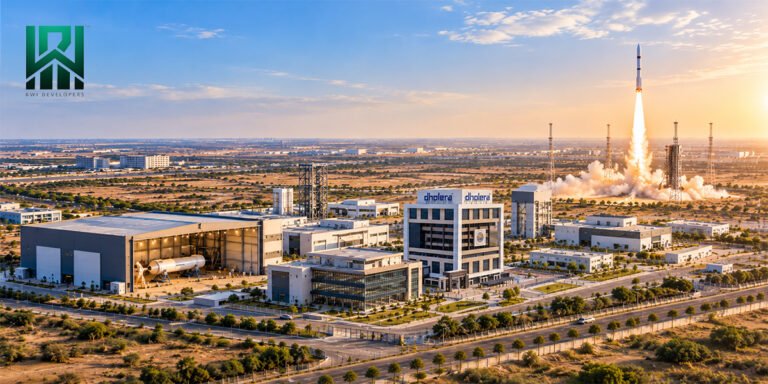
Dholera has been at the centre of India’s plans for next-generation industrial development for several years. However, recent developments in India’s semiconductor sector are giving the region a new dimension.
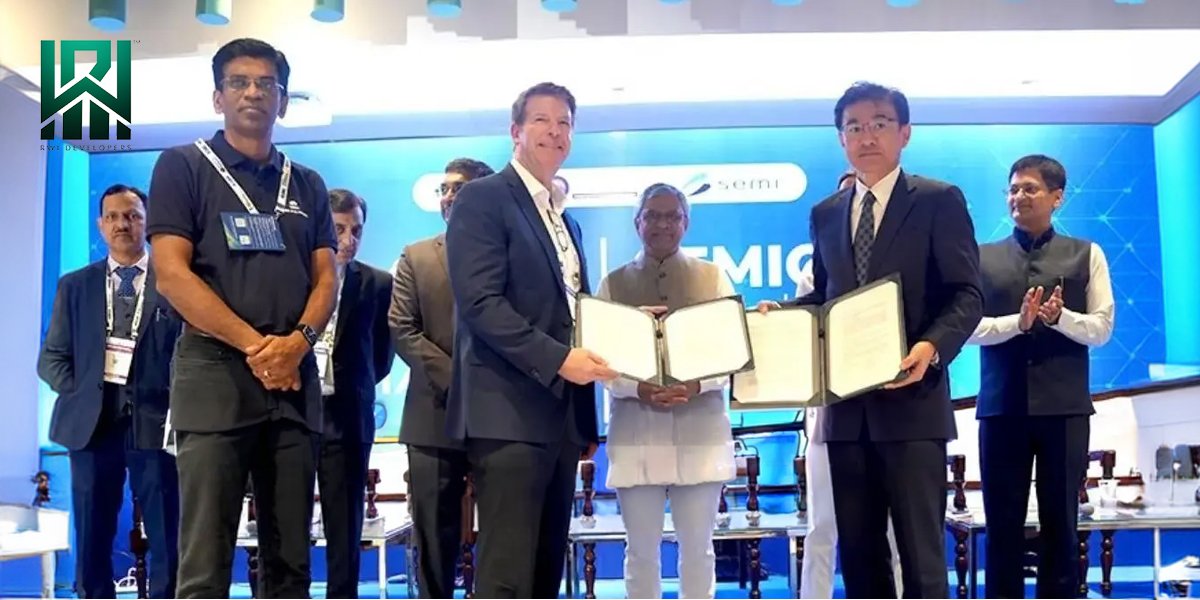
The latest edition of SEMICON India 2026, held in New Delhi from September 17 to 19, brought together more than 600 exhibitors and participants from 52 countries under the theme “Silicon to Systems: Building the Ecosystem.” The event highlighted India’s expanding semiconductor capabilities across manufacturing, packaging, materials, equipment, research and development, and talent.
For Dholera, the significance goes beyond the semiconductor fab itself. Tata Electronics confirmed that construction of its 300mm semiconductor fabrication facility in Dholera is on track, while the company announced multiple partnerships covering wafer manufacturing, assembly and testing, advanced semiconductor packaging, photoresists, advanced chemicals, critical materials and talent development.
Perhaps most significantly, Tata Electronics and Ascendas First Space signed an MoU for the development of a 363-acre vendor park in Dholera to accelerate the supplier ecosystem around the semiconductor fab.
Together, these developments provide an important signal for anyone studying Dholera investment and the long-term potential of land in the region.
From a Semiconductor Fab to a Wider Industrial Ecosystem
A semiconductor manufacturing facility does not operate in isolation.
A modern semiconductor ecosystem requires suppliers of specialised materials, chemicals and equipment, packaging and testing capabilities, logistics providers, engineering services, maintenance companies, technology partners and a trained workforce.
This is precisely why the developments announced around SEMICON India 2026 are important for Dholera.
The proposed 363-acre vendor park is designed to support the supplier ecosystem around Tata Electronics’ semiconductor facility. At the same time, the company’s agreements with international technology and manufacturing partners are aimed at developing capabilities across several parts of the semiconductor value chain.
This creates a broader economic proposition.
Instead of viewing Dholera as the location of one large industrial project, it is increasingly possible to view the region as an emerging manufacturing ecosystem.
That distinction matters for real estate.
Industrial ecosystems tend to create demand for more than factories and industrial land. They can also support requirements for logistics, offices, services, accommodation, retail, education and residential communities as economic activity develops.
This does not mean that every parcel of land will automatically appreciate. Location, infrastructure, approvals, surrounding development and the eventual pace of urbanisation remain critical. However, the expansion of the economic base provides an important factor for investors evaluating the long-term potential of land for sale in Dholera.
Why Semiconductor Manufacturing Could Change Dholera’s Growth Story
The Tata Electronics semiconductor fab has been approved with an investment of approximately ₹91,526 crore and a planned production capacity of around 50,000 wafer starts per month.
The scale of such a facility is significant, but its wider impact can potentially extend beyond the factory gates.
A large manufacturing project requires an ecosystem around it. Suppliers need to be located within an efficient logistics network. Employees need access to transportation and supporting infrastructure. Businesses serving the industrial ecosystem need locations that are accessible to their customers and workforce.
Over time, this can contribute to a wider process of economic concentration.
The same principle can be seen in industrial regions around the world: when a major manufacturing cluster develops, ancillary businesses and supporting services can follow.
Dholera’s semiconductor development therefore has significance not simply because of the value of the fab itself, but because of the network of economic activity that can develop around it.
For someone researching plots in Dholera Smart City, this broader ecosystem is an important part of the investment conversation.
Dholera SIR: The Larger Development Framework
The semiconductor story also needs to be understood within the much larger Dholera Special Investment Region (Dholera SIR).
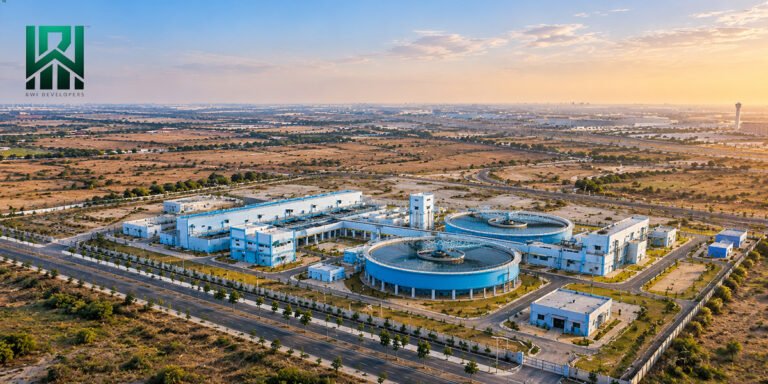
Dholera SIR is being developed as a large greenfield industrial investment region with planned infrastructure spanning transportation, water, power, wastewater management, drainage and urban development. Gujarat’s industrial policy identifies sectors including electronics and high-technology industries among the region’s focus areas.
This is important because the semiconductor industry is not developing in isolation from Dholera’s broader industrial planning.
The combination of a large planned industrial region and specialised high-technology manufacturing creates the possibility of multiple layers of development occurring simultaneously.
For land investors, that distinction is significant.
A location supported by a broader industrial and infrastructure ecosystem can have a different long-term investment proposition from land whose development depends on a single isolated project.
This is one reason Dholera Smart City Gujarat has attracted increasing attention from investors looking at long-term land opportunities.
Infrastructure Is an Important Part of the Investment Equation
Industrial growth needs connectivity.
Dholera is receiving substantial infrastructure investment designed to connect the region with Ahmedabad and other parts of Gujarat.
The Ahmedabad–Dholera Greenfield Expressway, stretching approximately 109 kilometres, provides connectivity between Ahmedabad and Dholera SIR. In February 2026, the Ministry of Road Transport and Highways stated that the expressway had been opened to the public for testing while final operational readiness was being assessed.
Rail connectivity is also being strengthened. In May 2026, the Union Cabinet approved the approximately 134-kilometre Ahmedabad (Sarkhej)–Dholera Semi High-Speed Double Line project, with an estimated cost of ₹20,667 crore. The project is planned to connect Ahmedabad with Dholera SIR, the upcoming Dholera Airport and the Lothal National Maritime Heritage Complex.
Dholera’s airport is another important component of the region’s connectivity strategy. The Union government has described the airport as intended to serve Dholera SIR and the surrounding industrial region, including cargo requirements. In July 2026, the Ministry of Civil Aviation reviewed progress on the airport and outlined a roadmap towards completion and operationalisation.
Taken together, these projects demonstrate why connectivity should be considered alongside industrial investment when evaluating Dholera land investment.
What Does This Mean for Land Investors?
For a long-term land investor, the most important question is not simply whether a major project is being built nearby.
The more useful question is:
What economic ecosystem is developing around the land?
Dholera increasingly offers several components that investors typically examine when evaluating emerging growth corridors:
- Large-scale industrial investment
- High-technology manufacturing
- Planned industrial infrastructure
- Improving road connectivity
- Upcoming rail connectivity
- Airport development
- Supplier and ancillary industries
- Government-backed regional planning
- Potential employment generation
- Expansion of commercial and residential activity
SEMICON India 2026 adds another important element to this picture.
The event saw approximately ₹1 lakh crore in semiconductor investment commitments and close to one lakh expected employment opportunities across India’s semiconductor ecosystem. These figures apply to the broader national ecosystem rather than Dholera alone, but the announcements involving Tata Electronics specifically reinforce Dholera’s role within India’s semiconductor manufacturing ambitions.
For investors considering whether to buy land in Dholera, this broader context can be more meaningful than focusing on short-term market movements.
Why Location Within Dholera Matters
The development of an entire region does not mean every location will benefit equally.
For land investors, micro-location remains critical.
Connectivity to industrial areas, major roads, planned infrastructure, employment centres and emerging commercial zones can influence how useful a parcel of land becomes as the surrounding region develops.
This is particularly relevant when evaluating Dholera SIR plots or residential plots in and around the broader Dholera development area.
Investors should therefore examine factors such as:
Connectivity: How easily can the land connect to major roads and transportation corridors?
Infrastructure: What infrastructure is already available, and what is officially planned?
Development status: Is development actually progressing around the location, rather than existing only in long-term plans?
Land documentation: Are ownership records, approvals, land-use permissions and other documentation clear?
Surrounding ecosystem: Are industrial, residential and commercial developments emerging nearby?
Long-term usability: Could the location potentially support residential, commercial or other permitted uses as the region develops?
These considerations are particularly important for people researching Dholera plots for sale because the label “Dholera” alone does not establish the investment quality of a particular parcel.
The Long-Term Case for Dholera Land
The investment case for Dholera is therefore best understood as a combination of factors rather than a single announcement.
The region has a large planned industrial framework through Dholera SIR. Major transportation infrastructure is being developed. The semiconductor sector is establishing a significant manufacturing presence. And, following SEMICON India 2026, the semiconductor ecosystem around Dholera is showing signs of becoming broader through supplier and technology partnerships.
The proposed 363-acre vendor park is particularly relevant because it points towards the development of supporting industrial activity around Tata Electronics’ semiconductor facility.
As this ecosystem develops, the potential requirement for housing, services, logistics, commercial activity and supporting infrastructure can also increase.
That is the fundamental reason Dholera is attracting attention from people considering land as a long-term asset.
Rather than relying solely on speculation about future prices, investors can examine the underlying drivers: industrialisation, infrastructure, connectivity, employment and urban development.
Is Dholera a Good Investment in 2026?
There is no universal answer to whether any individual parcel of land is a good investment. Real estate remains location-specific, and future appreciation cannot be guaranteed.
However, the developments taking place in 2026 provide investors with substantially more tangible factors to examine when considering Dholera investment.
The semiconductor sector is moving from policy announcements towards physical manufacturing capacity. Tata Electronics has confirmed that construction of its Dholera fab is on track, while the surrounding supplier ecosystem is being developed through new partnerships.
At the same time, road, rail and airport infrastructure are progressing around Dholera.
This combination is what makes the region particularly interesting from a long-term land-investment perspective.
For investors exploring buy land in Dholera, plots in Dholera Smart City, or other opportunities within the Dholera SIR ecosystem, the semiconductor story provides another reason to examine the region closely.
A New Phase for Dholera
Dholera’s development story has been discussed for years. SEMICON India 2026 suggests that the next phase could be increasingly defined by actual industrial activity and the ecosystems that develop around it.
The semiconductor fab is one component. The vendor ecosystem is another. Transportation infrastructure, airport development and the wider Dholera SIR framework provide the supporting foundation.
Together, these developments create the conditions for a larger economic ecosystem to emerge.
For land investors, that makes Dholera worth watching—not because appreciation is guaranteed, but because the fundamentals behind the region’s development are becoming increasingly tangible.
The key for investors will be to look beyond headlines and evaluate the specific location, connectivity, approvals, infrastructure and development status of any land they consider.
As Dholera’s semiconductor ecosystem takes shape, land in strategically connected parts of the region could become an increasingly relevant asset for investors seeking exposure to India’s next generation of industrial and urban development.