Dholera has increasingly become associated with semiconductors, advanced manufacturing, infrastructure and the development of a greenfield smart city.
But another technology sector has begun to enter the region’s story: space technology.
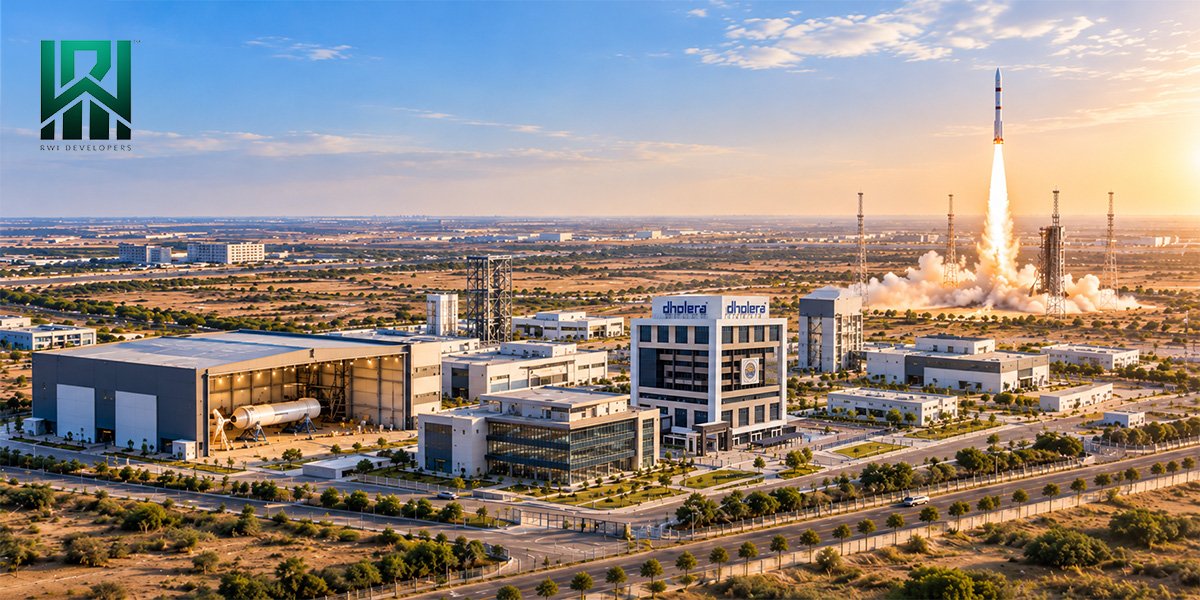
In March 2026, Gujarat recorded its first sounding-rocket launch from the Dholera region. The single-stage sub-orbital rocket was developed by Ahmedabad-based startup OmSpace Rocket and Exploration and launched from a temporary facility at Bavaliyari near Dholera. The rocket reached an altitude of approximately three kilometres and carried a mini-satellite designed to collect weather data.
The launch does not mean Dholera has suddenly become a major spaceport.
Its significance lies elsewhere.
It demonstrates how the region is beginning to connect with India’s expanding private space and advanced-technology ecosystem.
What Is a Sounding Rocket?
Before looking at its significance for Dholera, it is important to understand what a sounding rocket actually is.
A sounding rocket is a sub-orbital vehicle used to conduct experiments, collect scientific data and test technologies at high altitude.
Unlike an orbital launch vehicle, it does not place a satellite into orbit.
The March 2026 launch near Dholera was a single-stage sub-orbital mission that reached approximately three kilometres. It also carried a mini-satellite designed to collect weather information.
That makes it a technology demonstration and research activity rather than a conventional satellite launch.
Why Was the Dholera Launch Significant?
The importance of the launch goes beyond the altitude reached by the rocket.
The vehicle was developed by an Ahmedabad-based private startup, with its airframe using carbon fibre and advanced composites.
The launch was conducted under the authorisation of IN-SPACe and supported by Gujarat’s SpaceTech Policy 2025–2030.
This is significant because it demonstrates the growing role of private companies in India’s space sector.
For Dholera, it creates a connection between the region and a technology ecosystem that includes aerospace engineering, advanced materials, propulsion, electronics and research.
Dholera and India’s Private Space Sector
India’s space sector has undergone a major shift in recent years.
Private companies are increasingly involved in areas such as:
- Launch vehicles
- Satellite technology
- Propulsion
- Earth observation
- Communications
- Space electronics
- Advanced materials
- Navigation
- Ground systems
This creates opportunities for specialised industrial clusters.
Dholera’s broader industrial strategy already includes advanced manufacturing and high-technology sectors, making space technology a potentially complementary area of development.
The Connection Between Semiconductors and Space Technology
At first glance, semiconductor manufacturing and rocket development may appear unrelated.
In practice, advanced technology sectors often share parts of the same industrial ecosystem.
Space systems can require:
- Advanced electronics
- Sensors
- Semiconductor components
- Precision manufacturing
- Embedded systems
- Communications technology
- Advanced materials
- Testing facilities
Dholera’s semiconductor ecosystem could therefore become relevant to other high-technology industries over time.
This does not mean that every semiconductor facility automatically becomes a supplier to the space industry.
Rather, it demonstrates why developing several advanced-technology capabilities within the same region can create opportunities for industrial linkages.
Advanced Materials and Aerospace Engineering
The sounding rocket launched near Dholera used carbon fibre and advanced composite materials in its airframe.
Advanced materials are important across several technology-intensive industries.
They are used in:
- Aerospace
- Defence
- Spacecraft
- Automotive engineering
- Electronics
- Industrial equipment
This creates another potential connection between Dholera’s developing manufacturing ecosystem and India’s aerospace and space ambitions.
Dholera’s Broader Advanced-Manufacturing Story
The space-tech development should not be viewed in isolation.
Dholera’s industrial development is already associated with semiconductor manufacturing and other high-technology industries.
The region is also being developed around large-scale infrastructure, including industrial utilities and transportation connectivity.
This creates the possibility of a broader ecosystem built around advanced manufacturing.
A simplified view of that ecosystem could look like:
Semiconductors → Electronics → Advanced Manufacturing → Aerospace → Space Technology
The sectors are not interchangeable, but they can share infrastructure, skills, suppliers and technology capabilities.
Gujarat’s SpaceTech Policy
The sounding rocket launch was supported by Gujarat’s SpaceTech Policy 2025–2030.
The policy framework is intended to encourage the state’s participation in India’s growing space economy and create opportunities for private-sector companies.
This matters because industrial ecosystems generally require more than physical land.
They also require:
- Policy support
- Skilled talent
- Research capabilities
- Infrastructure
- Investment
- Technology partnerships
- Regulatory frameworks
The combination of these factors can influence where emerging technology clusters develop.
Why Dholera’s Planned Development Matters
Dholera is being developed as a greenfield smart city and Special Investment Region.
The Gujarat government’s investment information describes Dholera SIR as a major planned greenfield industrial region with infrastructure intended to support sectors including electronics, high technology, defence and engineering.
That makes it relevant to technology sectors that need specialised industrial infrastructure.
The space-tech ecosystem is still at an early stage in relation to Dholera.
But the region’s broader development model provides an environment in which advanced manufacturing and technology companies can potentially operate alongside one another.
What Could a Space-Tech Ecosystem Mean for Dholera?
If space-related activity expands over time, it could create demand across multiple supporting areas.
These could include:
- Engineering
- Electronics
- Component manufacturing
- Advanced materials
- Testing
- Software
- Research
- Logistics
- Skilled technical services
Such activity can contribute to the development of a broader industrial ecosystem.
It can also strengthen the region’s identity as a location for technology-intensive businesses rather than only conventional manufacturing.
From Semiconductor City to Technology Hub?
Dholera’s semiconductor development has already changed how the region is discussed.
The next stage may be about understanding how different technology sectors interact.
Semiconductors can support electronics.
Electronics can support aerospace and space systems.
Advanced materials can serve multiple high-technology industries.
Digital infrastructure can support data-intensive businesses.
And planned industrial infrastructure can provide the physical foundation for these activities.
The result could be a more diversified technology ecosystem.
However, this is a long-term possibility rather than an established outcome.
What Does This Mean for the Dholera Project Current Status?
The sounding-rocket launch is a useful example of why Dholera’s development should be evaluated through more than one type of infrastructure.
The visible story includes roads, airports and industrial facilities.
The less visible story includes technology companies, specialised skills, research and advanced manufacturing.
The March 2026 launch provides a concrete example of private space-sector activity taking place in the Dholera region.
At the same time, it is important not to overstate the development.
One sounding-rocket launch does not establish Dholera as a major space hub.
It does, however, demonstrate that the region is participating in an emerging technology ecosystem.
What Comes Next?
The future development of Dholera’s space-tech ecosystem will depend on whether more companies, facilities, research initiatives and technology projects follow.
The development of semiconductor manufacturing could provide one technological anchor.
Aerospace initiatives could provide another.
Digital infrastructure and advanced manufacturing could further broaden the ecosystem.
If these sectors develop alongside the region’s planned infrastructure, Dholera could gradually become associated with a wider range of high-technology industries.
For people tracking Dholera Smart City, Dholera SIR and the broader Dholera investment story, this is an important development to follow.
The significance of Dholera may ultimately lie not in any single project, but in whether multiple advanced industries begin to operate within one integrated industrial region.
Frequently Asked Questions
What happened during the first sounding-rocket launch near Dholera?
An Ahmedabad-based startup launched a single-stage sub-orbital sounding rocket from a temporary facility at Bavaliyari near Dholera in March 2026. The rocket reached approximately three kilometres and carried a mini-satellite for weather data collection.
Was the rocket an orbital launch vehicle?
No. It was a sounding rocket, meaning it was designed for sub-orbital testing and research rather than placing a satellite into orbit.
Why is the launch relevant to Dholera?
It demonstrates the region’s connection with India’s emerging private space sector and advanced engineering ecosystem.
How is space technology connected to semiconductors?
Space systems can require specialised electronics, sensors, semiconductor components, communications technology and advanced materials. These overlapping capabilities can contribute to broader technology ecosystems.
Does the launch mean Dholera is now a major space hub?
No. The launch represents an early development rather than an established space-industry cluster. Its significance is that it demonstrates emerging private-sector space activity in the region.